Posts

Showing posts with the label aws

The Benefits of AWS DirectConnect
Image
AWS DirectConnect enables organisations to establish dedicated and private network connections between their data centre and AWS Availability Zones. This service provides a secure, reliable, and high-bandwidth connection, creating a direct, Point-To-Point (PTP) link between the organisation and AWS. Without DirectConnect, data would have to be transmitted over the public internet. This adds an added risk that organisations may want to avoid. Without AWS DirectConnect: The organisation would have had to expose its data centres via public IP addresses because connectivity to AWS would take place over the internet. On the public internet there may be nodes that operate the harvest-now, decrypt-in-the-future surveillance strategy that relies on the acquisition and long-term storage of currently unreadable encrypted data awaiting possible breakthroughs in decryption technology that would render it readable in the future. When using the public internet, the maximum possible perfo...
How Software Obsolescence Impacts Organisations

Image
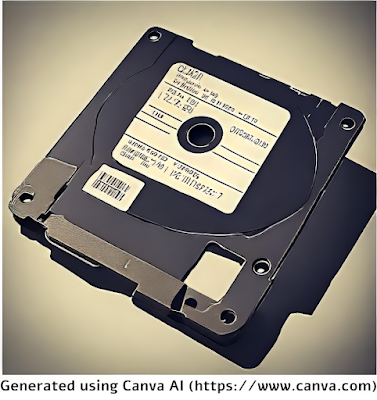
Any organisation that uses software must deal with the topic of software obsolescence. Irrespective of whether end users interact directly with it or if it is embedded within a device, the day will come when the software is outdated and no longer supported. Software obsolescence happens because of technological, functional, regulatory, and security factors, or a combination of them. Organisations mature and evolve through mergers, acquisitions, organic growth, and changes in company direction. Each one of these adds systems that will someday become obsolete. Ignoring software obsolescence has consequences, namely: Security risks: Outdated software is more likely to have known security vulnerabilities that can be exploited by attackers. Compliance risks: Organisations that use outdated software may be in violation of government regulations. Performance issues: Outdated software may not run as efficiently as newer software and may not be compatible with newer hardware. Compatibilit...

Amazon Polly

Image
Amazon Polly is a TTS (Text-to-Speech) service that, according to Amazon, uses deep learning. The GUI interface is straightforward; one selects one of the two engines, Neural or Standard. Neural is more human sounding. Languages and voices can vary depending on the engine. Voices reflect the dialect, register, and jargon that are typical for a region or country. For example, under English, there are Australian, British, Indian, Irish, New Zealand, South African, US, and Welsh variations. Once the language is selected, the Voice drop down list is populated with available voices for that language. As with languages, certain voices are only available for a particular engine. Voices vary in pitch, loudness, speed, and tonality to simulate different ages and sexes. These controls make it possible to generate speech as a young girl or an old man. There is an option to enable Speech Synthesis Markup Language (SSML) to fine-tune the generated output. Amazon supports a subset of the W3C SS...

AWS vs Azure Health Dashboards

Image
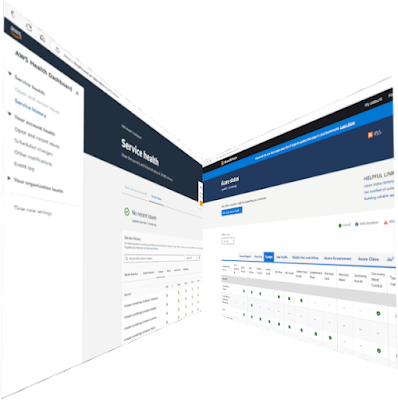
A Health Dashboard is a single source one could visit to learn about the availability and operations of IT systems. Both AWS and Azure provide Health Dashboards that allow users to view the overall status of their services. They offer a public version as well as a version available to logged-in customers. Both companies automatically update their publicly accessible sites every few seconds and provide an RSS feed to allow alerts to be sent to subscribers' RSS readers. The portal addresses are https://health.aws.amazon.com/health/status and https://azure.status.microsoft/ .  Besides active alerts, both services share a log of incidents that have taken place.  Every Azure incident has an ID. Azure is better than AWS when it comes to handling the aftermath of the incident. Azure incident management describes what happened, what went wrong and why, and how Azure responded. The report adopts the lessons learned approach by sharing what actions Azure is taking to reduce the risk an...

Cloud Service Topologies Explained

Image
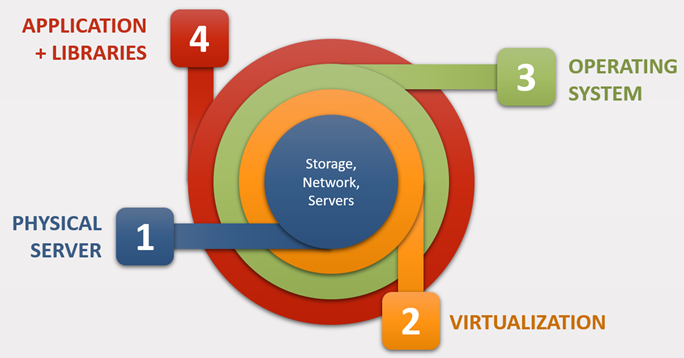
Imagine a company wants to commission a new application.  The application needs computing resources to be able to run. On many occasions the app references libraries, frameworks, software development kits (SDKs) and other software to run. The app and support programs are installed on a particular version of an Operating System (OS). To run, the solution requires resources such as CPU, memory, disk storage and networking. These are provided by physical servers. Virtualization lies between the Physical Servers and the OS and makes computing environments independent of physical infrastructure. A single app may require multiple virtual machines (VM). This may be necessary for redundancy purposes and/or because the application requires additional components that would be installed on separate VMs. Typically, the database used by the app or it web front end may reside on their own VMs. If this application was running on-premises one would...